

What’s the difference between Agile and Scrum?
In Agile, the project that leads to the development of a new software is commonly referred to as an “iteration” or “sprint”. These iterations are extremely dynamic and can last from one to three weeks.
Differing from the traditional approach on software engineering, Agile Methodologies aim to develop dynamic and nondeterministic characteristics. Additionally, their predictions are not addressed at an early stage, and all requirements and design features are prioritized.
Above all, rather than functioning as a project oriented tool, Agile supports a product oriented mindset. This makes it easier in the case we need to apply strategies focused on individual goals. Furthermore, it provides significant flexibility throughout the whole development process.
The Scrum Methodology is, precisely, one of the most popular software development frameworks based on the Agile Methodology. Accordingly, Scrum is a software development framework used by project managers to manage teams and achieve goals in a timely manner. The reason why Scrum guarantees efficient work is because it implements Agile methods and principles.
Scrum is, however, one of many Agile-based frameworks on the market. Project managers can now opt to choose different frameworks to work on their teams and improve efficiency, learning different software languages from each framework, even though they all are based on the same Agile principles.
Software development project management is immersed in a tech environment that evolves quickly and frameworks are often born or reinvented to meet the needs of different assignments.
Keep in mind that Scrum is a framework based on the Agile Methodology.
Scrum was originally created in the early 1990s by Jeff Sutherland and Ken Schwaber, who introduced the concept at the OOPSLA Conference in 1995. Their goal was to help teams improve collaboration and deliver products faster through short, iterative cycles. Over time, the framework was documented and refined into what is now known as the official “Scrum Guide.” This guide, continually improved by Sutherland and Schwaber, serves as the global reference for how Scrum teams operate.
At its core, Scrum focuses on small, cross-functional teams that deliver value through short cycles called sprints. Each team includes all the necessary skills to design, build, test, and deliver increments of the product without depending on other departments. This autonomy enables faster decision-making, greater ownership, and adaptability when priorities change.
All Agile based frameworks in software development are used to implement the completion of tasks and achieve goals in an efficient and timely manner.
Scrum is a framework for software development management that enables project planning on small teams. It allows the distribution of tasks that are completed in fixed duration cycles called “sprints”.
Each sprint starts with a clear objective, a “Sprint Goal,” which defines what the team intends to accomplish. To reach that goal, the team creates a “Sprint Backlog”, a subset of tasks selected from the larger “Product Backlog.” The Product Backlog is managed by the Product Owner and represents everything that might be needed in the product, while the Sprint Backlog contains only the items the team commits to complete during that sprint. This structure keeps priorities visible and transparent for everyone involved.
What are the 5 key steps of Scrum?
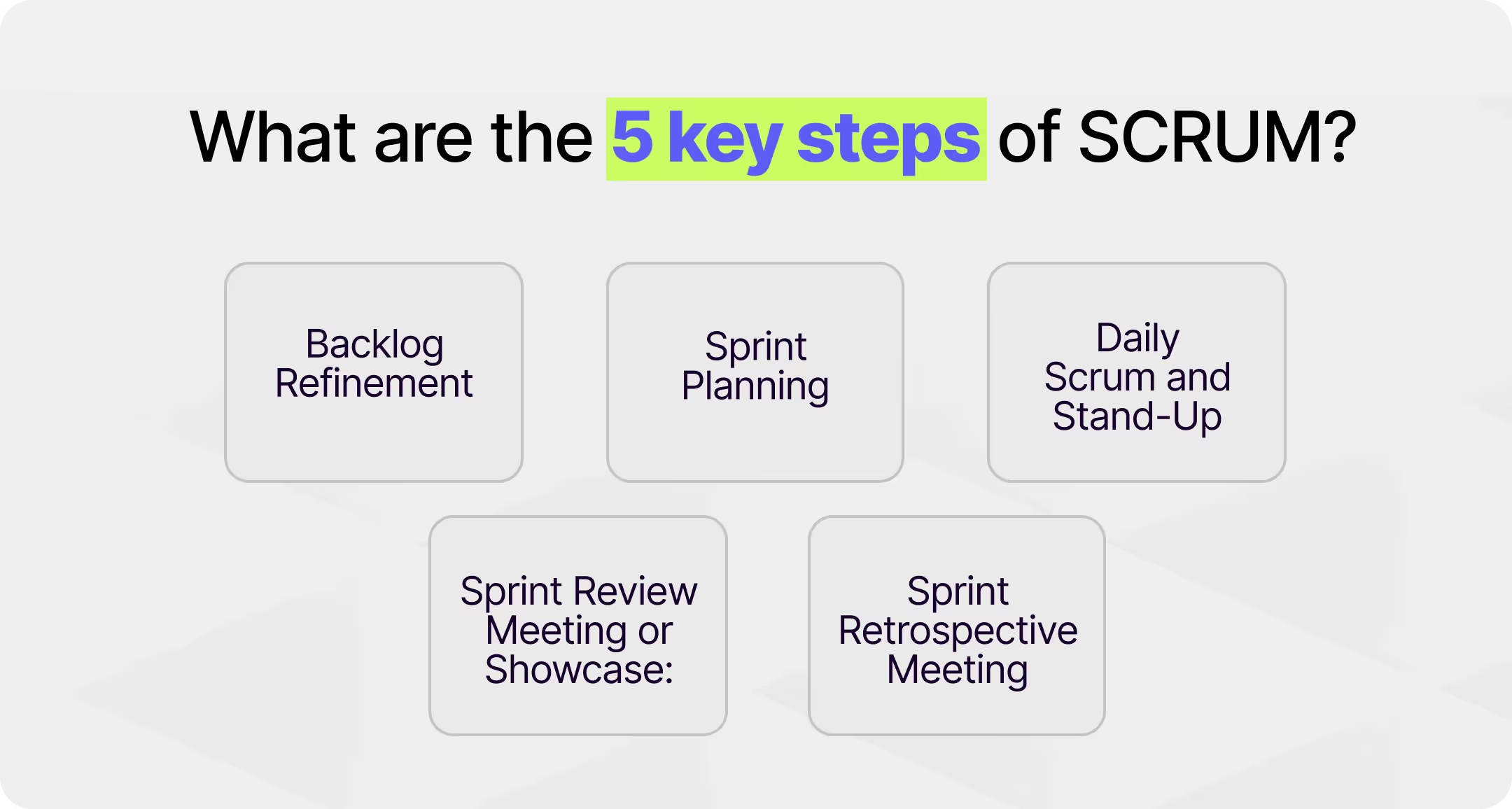
Backlog Refinement: All team members participate in a conversation where ideas and concerns are shared and discussed.
Sprint Planning: Every sprint starts with a planning meeting. This is where the product owner summarizes the main goals of a new project, discusses ideas, and describes “stories” of what should be achieved.
The team members will study these stories and transform them into achievable and measurable tasks. Each sprint has an average duration of 7 to 15 days.
Daily Scrum and Stand-Up: Team members and scrum masters meet on a daily basis to share their progress and keep track of the sprint’s advancement. These short daily meetings help keep fluid communication and serve as a moment to take notes, outline priorities, ask for advice and plan tasks ahead.
Each member has from 30 seconds to a minute to explain what they did yesterday, what they’ll do today and whether they have blockers that don’t allow them to move forward.
Sprint Review Meeting or Showcase: By the end of a sprint, all the sprint backlog work is revised by the product owner, and it can be either accepted or rejected.
At this point, team members should be sure all tasks were well addressed and completed.
Sprint Retrospective Meeting: This is an exhaustive retrospective of the whole process to evaluate the latest sprint. This meeting is always chaired by the Scrum Master.
It serves as a tool to improve team efficiency, as it identifies the main obstacles encountered; what worked best; the product owner preferences; and what can be done in future sprints to improve effectiveness and assure better results.
“Each sprint has an average duration of 7 to 15 days.”
What is different about Scrum compared to other frameworks?
The principal key about Scrum is that it avoids the traditional sequential and empirical approach of other frameworks, it establishes the project direction according to the tasks that are already completed.
In the Scrum platform users can play 3 main roles: the product owner, the scrum master and the team members. The product owner sets, prioritizes and evaluates the software. Scrum team’s work and makes sure the product has flawless features and functionalities.
The Scrum Master is the professional in charge of monitoring the scrum processes, agile teams and meetings, he motivates them, and increases its efficiency.
Additionally promotes changes that ensure quality and timeliness. Whereas the team members are designers, testers, UX specialists, developers and ops engineers.
The iterations are referred to as “sprints”. By the end of a sprint, stakeholders evaluate the project progress and begin to organize the next steps. Scrum also organizes tasks in a fixed duration cycle, as a way to assure that all projects are concrete, adaptable and collaborative.
If you are thinking about implementing Scrum or any other Agile framework, we can help you. Devlane specializes in staff augmentation services. From product development to maintenance, we can help you out.
We've been developing tailored products for a variety of industries, from startups to SMBs and large enterprises. If you want to know more about us and what we can do to boost your project to develop one of your ideas you can do it here.


Other Blog Posts

Work-Life Balance: The Solution to High Turnover of Software Engineers?



Why hire Latin American Developers for your business?


Why Diverse Teams Drive Innovation